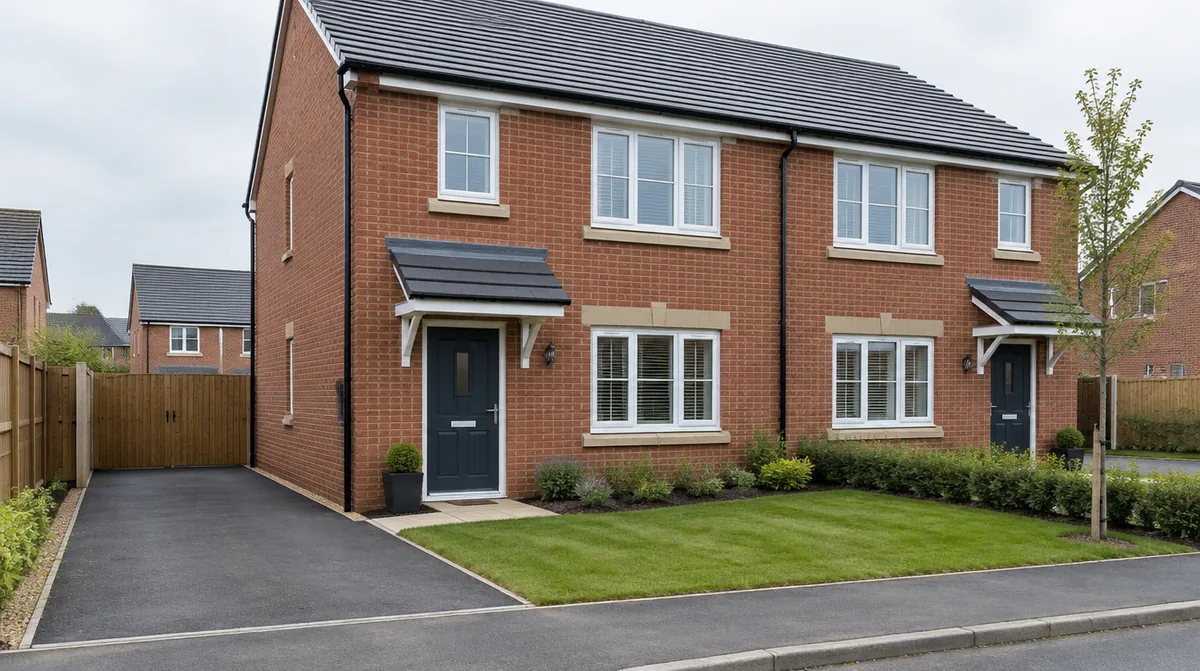
The Budget on 28 October confirmed the biggest change for first time buyers in England since Help to Buy closed. It is called Your First Home, it is a government equity loan, and it lets people buy a new build with a deposit of as little as 2.5%.
Here is the thing though. If you walk into your bank in April 2027 and ask about it, there is a fair chance the person in front of you will not be able to help, and not because they are being difficult. I want to explain why, and what the scheme actually says, because much of what is circulating this week is reported detail rather than published rule.
The firmest detail is not in the Budget speech. It is in the Budget 2026 Policy Costings document published by HM Treasury on 28 October 2026, which sets out the scheme on page 38. That note confirms the following.
The Budget document itself, at page 8, confirms £4.7 billion of funding for Your First Home. Worth noting that the same £4.7 billion figure appears elsewhere in the Budget in connection with defence spending, so if you see that number quoted loosely, that is why.
This is the part I would rather you heard from me than found out in six months. Several of the numbers being reported this week are not in any government document I can find.
Which? reported on 28 October 2026 that the income caps are expected to be £110,000 for households outside London and £140,000 inside it, that price caps could be £650,000 in inner London and £500,000 in outer London with other areas set by local authority median prices, that the maximum deposit is 15%, and that the equity loan is interest free for five years. Which? also set out an expected timetable of pre-registration by the end of December 2026 and applications from February 2027.
Those may all turn out to be right. But none of it is confirmed in the Treasury papers, and the interest rate applying after any interest free period has not been published anywhere. Neither has the list of participating lenders, nor whether the scheme covers England only. Treat those figures as a steer, not as the rules.
An equity loan is not a deposit gift and it is not a grant. The government lends you a slice of the purchase price, you put in your own deposit, and a normal mortgage covers the rest. On the confirmed terms, a 2.5% deposit plus a 20% equity loan leaves a mortgage of 77.5% of the price.
Take a £250,000 new build as an illustration.
Compare that with buying the same house with a 10% deposit and no equity loan. You would need £25,000 up front and a £225,000 mortgage. So the scheme could cut the cash you need by about £18,750 and cut the amount you borrow commercially by £31,250.
What does that do to the monthly payment? The average five year fixed rate reached 6% in early October 2026, according to Moneyfacts figures reported by ITV News on 5 October 2026. Using 6% purely as an illustration, over a 30 year term, £193,750 works out at roughly £1,162 a month against roughly £1,349 for the £225,000 version. Around £187 a month of difference, on those assumptions.
I am using that rate to show the shape of the maths, not to quote you a deal. Rates move constantly and what you could actually be offered depends on your circumstances. If you want to run your own figures, our mortgage repayment calculator will do it.
You repay the equity loan as a percentage, not as a sum of money. You borrowed 20% of the value, so you owe 20% of the value whenever you repay it.
If that £250,000 house is worth £275,000 when you sell, the 20% you owe is £55,000, not the £50,000 you received. The government shares your gain. And it works the other way too. If the house falls to £230,000, you would owe £46,000. That sounds like a comfort until you remember that your own equity takes the first hit, and that a 2.5% deposit on a new build leaves very little cushion if values dip in the early years.
This is the most important thing to understand before you sign anything, and it is the bit that gets lost when a scheme is described as "a 2.5% deposit mortgage".



Three reasons, and none of them are a conspiracy.
This is the plain structural point. A high street lender employs advisers to advise on that lender's range. If that lender is not on the Your First Home panel, the scheme is not something they can offer you, and in most cases it is not something they will raise. It is not in their range, so it is not in the conversation.
That is true of every government scheme, every niche lender and every specialist criteria case, which is the broader argument for whole of market advice. We have written about how that plays out when conditions are moving in mortgage broker versus bank when rates are rising.
Help to Buy is the obvious precedent. It launched in 2013 with a handful of lenders and widened over several years, because equity loan schemes need lenders to build specific products, train staff and accept a second charge sitting behind their own.
No participating lenders have been named for Your First Home. Until they are, nobody can tell you with confidence which mortgage will suit a Your First Home purchase, and anyone who says otherwise is guessing.
Even without the scheme, new build works differently. Offers often need to last longer because of build timescales, lenders can cap loan to value on flats differently from houses, and valuations can come in under the asking price once incentives are stripped out. Those are the things that actually sink new build applications. Our new build mortgage advice page covers the ground properly.
These two names will cause confusion all year, so let me separate them.
The First Homes scheme is the existing one, where eligible first time buyers buy a new build at a discount to market value, and that discount stays with the property when it is sold on. There is no government loan involved.
Your First Home is the new one. You pay full price and the government lends you 20% of it, which you repay later as a percentage of what the home is then worth.
Different mechanisms, different eligibility, different consequences on resale. If someone tells you the Budget "expanded First Homes", they have mixed the two up.
Sometimes, not always. Buying with 2.5% down means you could stop paying rent years earlier, and for a lot of people that is the whole point. But a smaller deposit means a bigger commercial mortgage, more interest over its life, and a government loan behind it that grows with your house price. A larger deposit typically opens up better rates and leaves more room if values move against you. There is a real trade off, and we go through the deposit side of it in how much deposit do you need for a mortgage.
It is also worth knowing that shared ownership is not going anywhere, and for some households it still works out better than a 20% equity loan. That comparison is exactly the sort of thing advice is for.
If you are hoping to buy a new build in 2027: worth planning around. First loans complete from April 2027, so a purchase completing before then cannot use it. If you are close to buying now, whether to wait depends on your rent, your savings rate and how firm your plans are.
If you are buying an existing home: the scheme does not apply to you at all. New build only. Nothing in the Budget changed stamp duty either, so the thresholds you were working to still stand.
If your household income is near six figures: keep an eye on the caps. The Treasury has confirmed income caps will exist but not what they are, and reported figures are not rules. If you are close to the line, do not commit to a purchase strategy on the strength of a newspaper number.
If you are saving in a Lifetime ISA: there was a separate change here. From 29 October 2026 the withdrawal charge drops from 25% to 20% where a first time buyer is purchasing above the £450,000 property price cap, which softens the penalty a little. A new First Time Buyer ISA follows from April 2029.
If you are not sure where you stand: that is reasonable. The rules are not out yet.
A few things are worth getting right.
We are a fee free, whole of market brokerage. You pay us nothing for the advice. We are paid by the lender once a case completes, so we have no reason to steer you towards one lender, and none to steer you towards a government scheme either if a straightforward mortgage serves you better. We set that out in what does a mortgage broker actually cost.
When the rules are published and the panel is named, we will know which lenders are on it and how their criteria compare, because looking across the whole market is the job. If you are thinking about a 2027 purchase, talk to us as a first time buyer and we will tell you honestly whether waiting makes sense for you.
HM Treasury has confirmed that the first loans will complete from April 2027. Reported timetables suggest pre-registration could open earlier, but those dates are not confirmed in government documents.
The Treasury says deposits can be as low as 2.5% of the purchase price. A larger deposit may still get you a better mortgage rate, so the minimum is not automatically the best choice.
No. The confirmed terms apply to new build homes only, bought by first time buyers.
The interest terms have not been published by the government. Press reports suggest an interest free period of five years followed by a rising charge, but that is not confirmed and the rate after any such period is not known.
Possibly. You repay 20% of the property's value at the time you repay, not the cash sum you received. If your home has risen in value, the amount you owe rises with it.
No. First Homes is a discount to purchase price. Your First Home is a government equity loan at full price. They work differently on resale.
This article reflects information published up to 29 October 2026 and is general information, not advice. Scheme rules had not been fully published at the time of writing and may change. Your home may be repossessed if you do not keep up repayments on your mortgage.

Get in touch early in your property journey, ideally before viewing or making an offer, to give yourself the best chance. Whether you’re exploring your borrowing capacity or ready to apply we’re here to help from the very beginning.
Ready to get started


Fee Free Mortgage Broker is a trading style of Alexander Southwell Mortgage Services Ltd, authorised and regulated by the Financial Conduct Authority (FCA) (FRN 1011890).
Registered in England & Wales (Company No. 11772228).
Registered office: Nix Business Centre, 2 Park Court, Abbey Park Industrial Estate, Romsey, Southampton, SO51 9DH. We are registered with the Information Commissioner’s Office, registration number ZA488146.
Information on this website is for general guidance only and is accurate at the time of writing. It does not constitute personalised financial advice. Mortgage criteria and lender policies can change; please speak to an FCA-authorised adviser for up-to-date advice tailored to your circumstances. Some buy-to-let mortgages are not regulated by the FCA.
Your home may be repossessed if you do not keep up repayments on a mortgage or any other debt secured on it.
© 2026 All rights reserved.